
Prince William County Resident Lookup Records
No countywide public occupant roll was located for Prince William County. Instead, each official source answers a narrower question. Prince William Real Estate Assessments can supply a named owner or tax-account role and separate the situs from the owner mailing address. A deed names grantors and grantees. Court indexes supply a party, case, and date lead. The voter and vital systems have their own access rules. Treat a result as a lead until the custodian and record type support the conclusion.
| Record trail | What it can confirm | Custodian or tool | Access boundary |
|---|---|---|---|
| Parcel assessment | Owner or tax role, GPIN, mailing and situs fields | Prince William Real Estate Assessments | Public portal, not occupancy proof |
| Recorded deed or plat | Grantor, grantee, legal transfer | Prince William Circuit Court Clerk | Index, clerk computers, or copy request |
| Court case | Party, case number, hearing or case detail | Virginia GDC or Circuit search | Portal lead; clerk file controls |
| Voter record | Registration, status, and district where authorized | Virginia elections system | Individual and authorized-list limits |
| Vital record | Family event or relationship | Prince William Health District Vital Records | Age windows and relationship rules |
| License or entity filing | Credential, entity, or business role | Virginia DPOR or SCC | Affiliation, not residence proof |
Begin with an address-linked record when the question is about a particular parcel. Begin with the court, historical-directory, or vital-record path when a date or family event is already known. Keep the name spelling, suffix, source URL, date, case or instrument number, GPIN, and person’s stated role together. Those details make later comparison possible without turning one indirect record into a claim about a complete household.
Prince William County Resident Court Searches
Virginia’s General District Court search requires selection of one court. For a name search, last name is required; first name, middle initial, and suffix are optional. It also accepts a case number or a hearing date in MM/DD/YYYY format. The data-status control distinguishes Current, Archived, and All. Current data begins after January 2007, while Archived covers earlier data. A two-character name plus an asterisk can be used as a wildcard where the portal permits it.
The GDC result path can show the selected court, case number, party name, hearing date, and details screen. Record the court, role, case number, status selection, and retrieval date before comparing a name to another source. The research did not open a live Prince William docket row, so a display result should not be paraphrased as the actual court file. A no-result search using Current alone does not show that an earlier case is absent.
View the controls in the official GDC search help before entering a name.
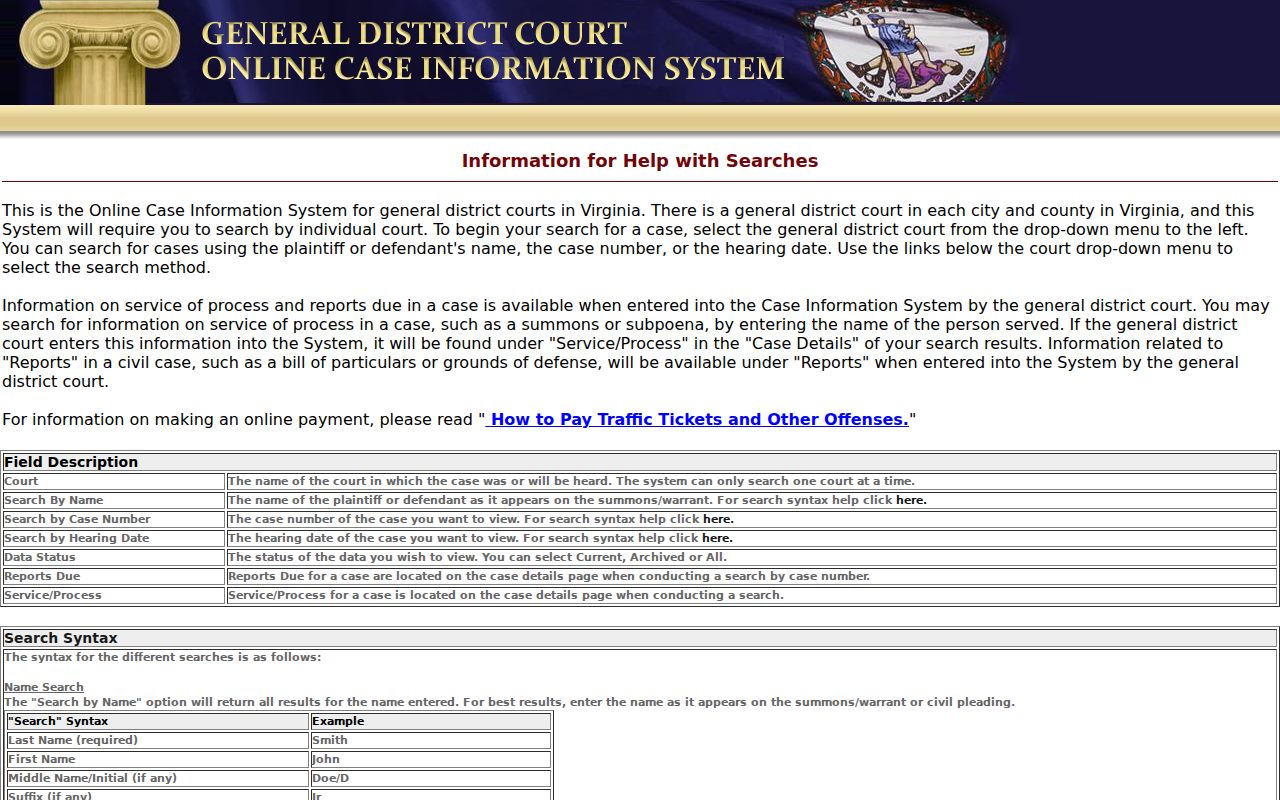
The screen shows why court, name fields, date, and data status should be saved with a court-search lead.
The Circuit Court search also works one court at a time and accepts party name, case number, or hearing date. Virginia’s court-information hub routes several case types, but it does not create a statewide civil Circuit Court search. For pleadings, orders, or certified material, use the clerk as custodian. Recent scanned cases may be viewed on public computers in the Criminal, Civil, and Public Service Center rooms at the Judicial Center, subject to the clerk’s access rules.
Compare the Circuit Court’s one-court search screen through the official portal.
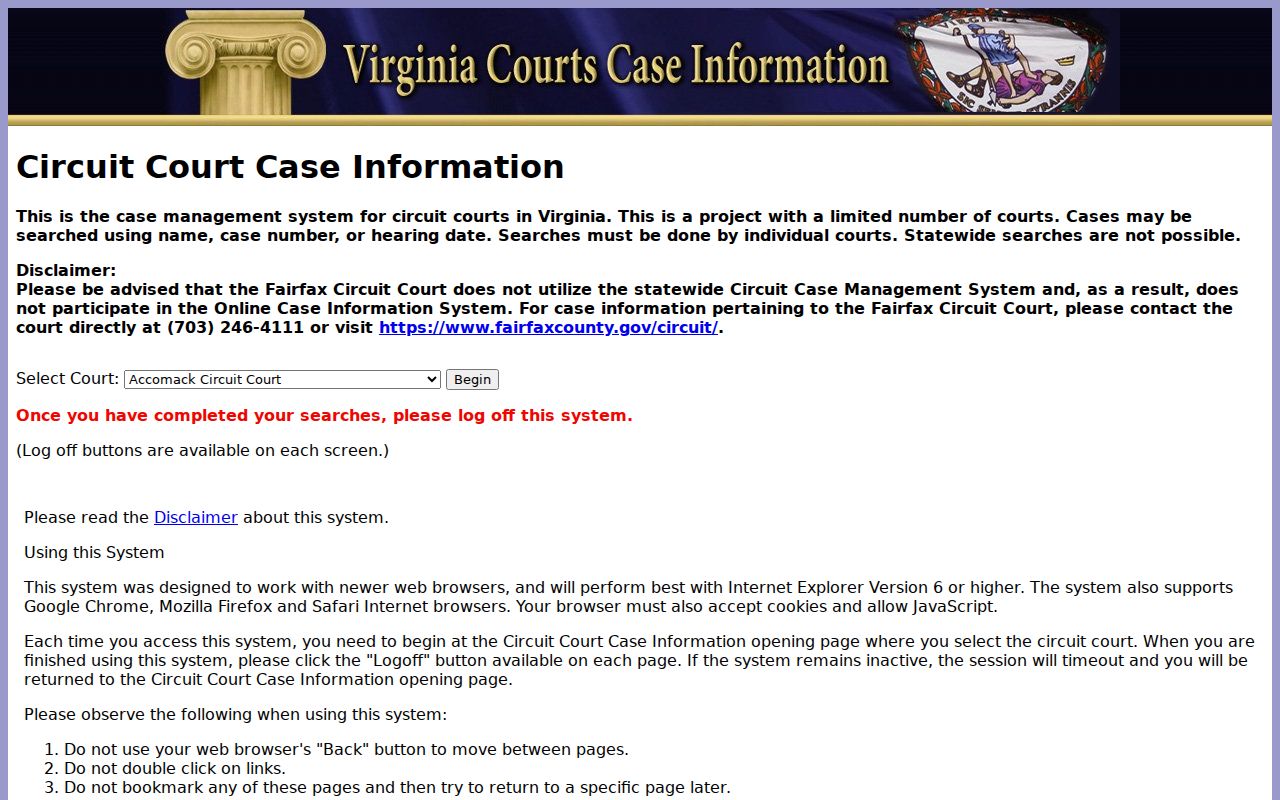
Online data can be incomplete or outdated, so the clerk’s document remains the authoritative record for an important case detail.
Note: A sealed, expunged, juvenile, adoption, or protected family-law record may not appear in a routine court search.
Prince William County Vital Record Limits
Prince William Health District Vital Records is the local route for Virginia births and deaths from June 14, 1912 to the present, marriage certificates from 1853 forward, and divorce certificates from 1918 forward. Birth records become public after 100 years. Death, marriage, and divorce records become public after 25 years. Before those windows, the local guidance generally limits access to immediate family, an authorized representative, or another statutory route.
The local office is at 8470 Kao Circle in Manassas. It lists walk-in hours Monday through Friday, 8:00 to 4:30, with arrivals after 4:00 potentially handled as next-business-day drop-offs. A request needs a signed application and legible identification. The local page lists $15 per certificate or search effective July 1, 2026, no refund when a record is not found, and a $10 amendment fee. The older marriage/divorce form shows $12, so use the current local page before sending payment.
The VDH online application separates event type, requester and event details, identification, electronic signature, payment, and tracking.
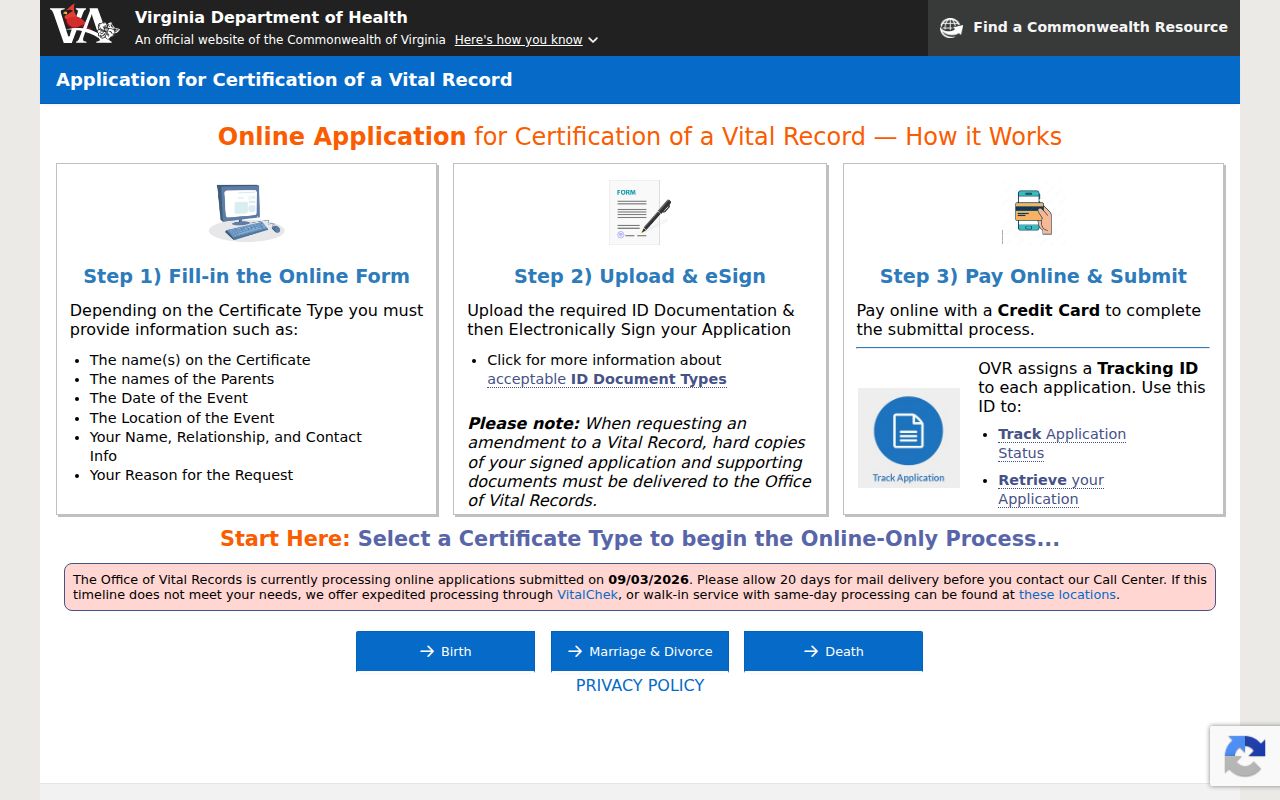
The application is a custodian request path, not an open name directory. Pre-1912 birth research and older genealogy material may require Richmond, the Library of Virginia, RELIC, church, cemetery, or county-register collections.
Prince William County Voter Record Boundaries
The Virginia citizen voter portal is the individual route for registration or update, polling place, districts, absentee status, and voting-history access. Its live field labels were not exposed during the research inspection. That limitation matters: do not substitute a scraped list for the voter portal or imply that an individual’s voting history is an ordinary public name field.
Virginia law provides registered-voter lists for public inspection at the general registrar, with defined fields and exclusions. The list can include name, address, year of birth, gender, and applicable districts, while Social Security information, registration-agency identity, day and month of birth, and some protected addresses are omitted. The state’s voter-list form also has locality, district, election type, start-date, and recurring-order fields, but it must be paired with the required Statement of Responsibility and eligibility rules.
The Prince William Office of Elections is at 9250 Lee Avenue, Suite 1, Manassas, and lists 703-792-6470. Published county pages show two different weekday closing times, so confirm hours before going in. The office or the state system is the correct channel for a record that the online service does not show.
Verifying Prince William County Resident Records
A useful resident lookup checks the same person against more than one independent record class. A parcel result may anchor a name to a GPIN, but it can show an owner mailing address rather than a person at the situs. A court or historical record can then supply a dated role. The final step is to ask the custodian for the document that supports the fact needed, rather than relying on an index row alone.
- Search the assessment portal by owner name or address and save the GPIN, the situs field, the owner-mailing field, and the assessment date.
- Use the name, middle initial, suffix, and a date range in the GDC or Circuit search. Select the correct court and save the case number and result status.
- For a land transfer, search the Circuit Clerk’s index by party name and GPIN, then reconcile the legal description or plat with the parcel rather than only the street number.
- Use a vital certificate, historical directory, voter route, or probate file only within its access rules. Request a certified copy or underlying court document from its custodian when that proof is required.
- Docket
- A court’s running case record, usually organized by case number, party, dates, and filings or events.
- Index versus image
- An index points to a record. The document image or clerk-held file is the source to inspect for the full text and any access limits.
- Certified copy
- A copy issued and certified by the custodian for a purpose that requires official authentication.
- GPIN
- Prince William’s hyphenated parcel identifier. It helps connect assessment, GIS, parcel-history, and land-record work.
Note: Preserve conflicting spellings, dates, and roles until the office that owns the record resolves the difference.
Prince William County Resident Name Checks
Common names need both a date check and a place check. Search the full name, last name with first initial, a suffix, and a former or maiden name only where the underlying record supplies it. Court searches support the GDC wildcard and Current, Archived, or All choices. Land work should use both party name and GPIN. A historical directory can be useful, but it often reflects a householder and a printed address for that edition rather than a current household.
Keep the record role visible in your notes. A deed result can be described as a named grantor or grantee. An assessment card can be described as an owner or tax role. An SCC filing may identify an officer, agent, registered office, or business address. None of those labels alone proves a person’s current physical presence. The same caution applies where city-labeled Manassas addresses and Prince William addresses share the Circuit Clerk’s land-record service.
For a dated household clue, RELIC’s historical collection is more useful than a broad name guess. A historical result can then be checked against the Prince William County directory book and its edition-specific context.
Prince William County Resident History Requests
A court index and a formal criminal-history request are different records paths. Virginia State Police offers the SP-167 general-public request route. It requires notarization. The regular search is listed at $15, and the criminal and registry combination at $20. The agency estimates roughly 15 to 20 business days and does not promise same-day or expedited service. Juvenile dissemination is restricted, and the service does not promise public arrest reports.
Review the request path on the Virginia State Police criminal-history service before submitting an application.
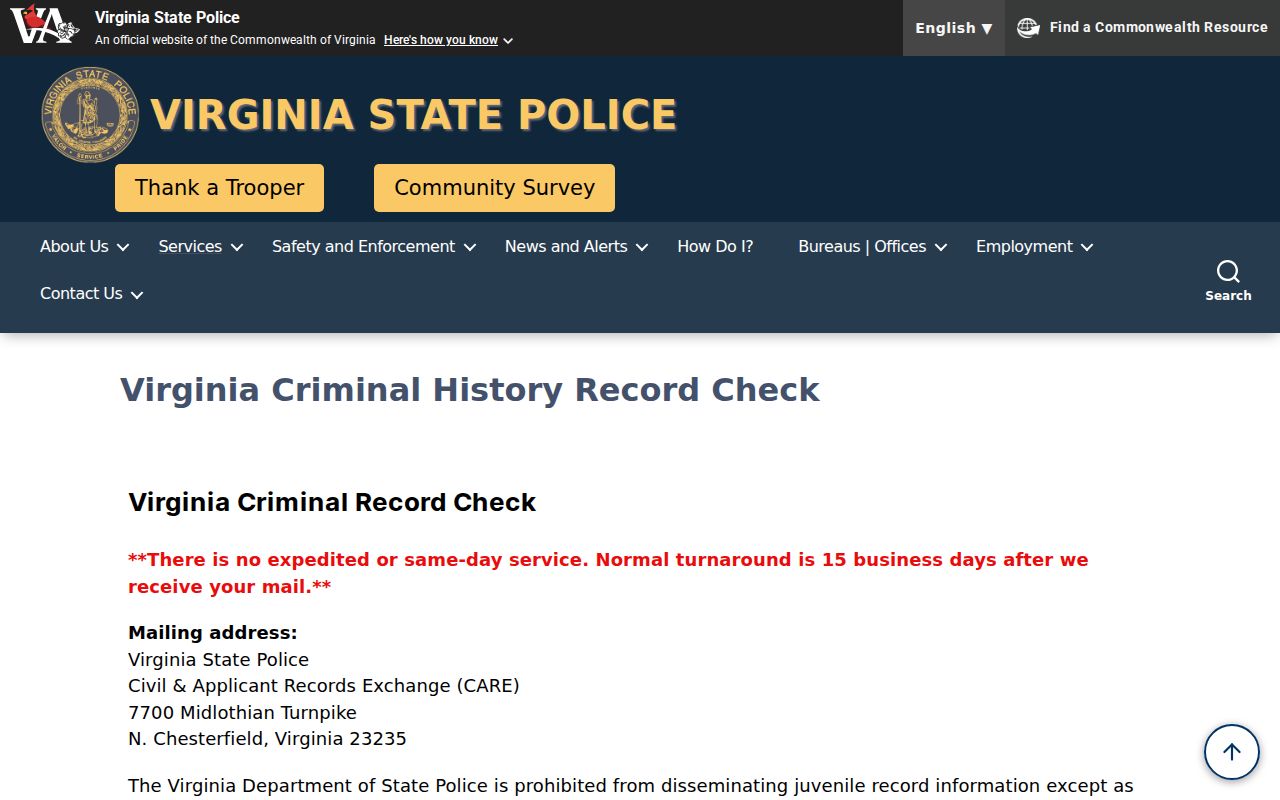
The state request is a formal custodian process with its own identification, fee, timing, and disclosure limits, not a substitute for verifying a court file.
Prince William County Resident Family Help
A name that disappears from current records may still be traceable through a dated household or event source. RELIC, the county’s genealogy and local-history collection, offers staff research help for people, places, and events. Its digital-preservation lab is free to use. RELIC also links researchers to census material, newspapers, family histories, obituaries, maps, local indexes, and research guides.
Use a printed spelling, edition or publication date, page number, and address exactly as the historical source gives them. A directory, obituary, newspaper, or family file supplies a dated historical lead. It should be verified through the relevant clerk, health, court, or archive channel before being used to connect the same name to a modern record.
Prince William County Resident Requests
When an official portal ends at a summary or an index, move to the office that keeps the underlying record. The Circuit Clerk handles land records and court-file channels. The Health District handles eligible vital-record applications. The registrar handles election records within Virginia’s restrictions. RELIC and the Library of Virginia hold historical collections that may be physical, microfilm, indexed, or partly digital. A request is stronger when it names the record type, event or document date, parties, GPIN or case number, and the specific copy needed.
For county records that are open under the Virginia Freedom of Information Act, Va. Code § 2.2-3704, make a reasonably specific written or oral request through the county’s FOIA route. The statute provides five-working-day response options and allows actual costs and, in some cases, a deposit. It does not override vital-record, court, voter, or other statutory confidentiality rules. Prince William lists its FOIA contact as foia@pwcgov.org and 703-792-6620.
The county jail has no official public web roster in the research findings. Current custody, charge, bond, next-court-date, and sentenced-release-date questions are routed to the Adult Detention Center at 703-792-6420. A missing online result is not evidence that a person is not in custody.
Prince William County Resident Addresses
Virginia’s Address Confidentiality Program gives eligible relocated survivors a substitute mailing address and mail forwarding while designated Attorney General staff and law enforcement protect the physical address. The program is free, lasts three years, and is not retroactive or absolute. Participants apply through a local accredited domestic- or sexual-violence or victim-witness program, not through a directory search.
The protection carries into election handling. A participant’s physical address is used for precinct assignment, but the substitute address appears on voter-facing records and cards. It is not appropriate to infer, reverse-geocode, or combine clues to reconstruct the protected location. This is the page’s human-use boundary: a legitimate family or records question must stop where the custodian marks an address confidential.
Lawful use. Use a Prince William County resident lookup for personal, lawful records research and never to stalk, harass, intimidate, or expose a protected person.
Prince William County Resident Lookup Limits
A resident lookup cannot turn property, court, voter, vital, business, or historical records into a single reliable occupant list. A tax account may have a different mailing and situs address. A business or professional record can identify a role or credential but not a home. Court data may be incomplete, outdated, sealed, or limited to an index. A vital certificate can be restricted even when an older newspaper or directory offers a name and date lead.
Use the narrowest accurate label for each result, save the retrieval date, and return to the clerk, registrar, Health District, assessment office, or archive when the official document is needed. For a question about a complete named street, use the address-focused Prince William County street directory workflow rather than expanding a one-person search into a block-wide profile.
Note: If two official sources conflict, retain both citations and dates instead of choosing the result that seems more convenient.