
Prince William County’s City Directory Shelf
Prince William County keeps no single public resident register. Instead, the dated books at the Ruth E. Lloyd Information Center, known as RELIC, anchor any historical residents directory search in this area. RELIC reports separate runs for Manassas, the Quantico-to-Occoquan corridor, and the county as a whole. Those scopes matter. A Manassas volume cannot prove a Woodbridge address, and a corridor book does not cover every county community. None of it is online. RELIC states that its comprehensive county directories and telephone books have never been digitized. So this is shelf work, not an online lookup.
| Collection | Years | Where Held | Access |
|---|---|---|---|
| Manassas-area directories | 1960 to 1983 | RELIC at Central Library | Physical or microform collection |
| Quantico, Triangle, Dumfries, Woodbridge, and Occoquan directories | 1963 to 1980 | RELIC at Central Library | Physical or microform collection |
| Prince William County directories | 2001; 2007 to 2020 | RELIC at Central Library | Physical or microform collection |
| Manassas telephone books | 1903, 1931, 1941, 1951 | RELIC at Central Library | Historical reference collection |
| Telephone directories | 1958 to 2009, with gaps | RELIC at Central Library | Historical reference collection |
Match the edition to the right community first. Recent households appear in later volumes. For an older Manassas question, the telephone books may be the only directory lead. Gaps mean something. A missing year can reflect the collection, the publisher's coverage, or the limits of one book rather than a household's absence. Note: A printed directory captures an entry in a single edition, not a complete roster for an address.
RELIC’s Prince William County Research Shelf
RELIC sits inside Central Library in Manassas as the local-history and genealogy center of Prince William Public Libraries. Its shelves hold local newspapers, maps, microforms, photographs, family histories, indexes, and guides. Staff research help is offered too. That mix matters when a dated directory supplies a name but not enough context to connect the person to a place or family. RELIC also runs a free digital-preservation lab. Bring family photos, letters, and address books there. Hours carry one caution. The official RELIC page shows two different staffed-hours blocks, so call before a special trip that depends on a microform reader or staff assistance. The center formerly lived at Bull Run Regional Library. It reopened at Central Library in November 2020. The RELIC collection page identifies the local-history center, its research support, and its contact details.
The collection page makes a smart first stop. Know what exists before asking for a directory year. RELIC's genealogy and local-history resources list census material, newspapers, obituaries, maps, PERSI, passenger lists, and library databases that can test a directory lead from another angle.
Copy the title, edition, and printed address down exactly first.
Prince William County Directory Geography
Directory labels follow publication markets. Public records follow legal custodians instead. Prince William County shares its map with the independent cities of Manassas and Manassas Park, and that overlap shapes every records search. The Circuit Court Clerk's land-record service covers all three. Assessment, zoning, police, cemetery, permit, and municipal-court work may sit elsewhere. Keep separate notes on the community label, the legal locality, the postal city, the ZIP, the parcel GPIN, and the custodian. A city label can mean a different municipal office. The distinction bites hardest around Manassas, Woodbridge, Dumfries, Triangle, Quantico, Occoquan, Lake Ridge, Dale City, Gainesville, Haymarket, Bristow, Nokesville, Catharpin, and Hoadly. The county's seven magisterial districts can filter elections, planning, association, and County Mapper work. They are not neighborhood names. A ZIP code is not a county line either. Once a historical address points to a modern candidate parcel, open the County Mapper to obtain the GPIN. Treat the map as informational only. The Clerk's recorded instrument or plat remains the legal source for boundaries and conveyances.
How Prince William County City Entries Read
Most entries start with name, address, and occupation. Twentieth-century editions go further. They may add a spouse, own-or-rent details, children, or business material. Marks vary by volume. RELIC publishes no downloadable entry page or abbreviation key, so read the key printed in the front of the same volume before drawing conclusions. Keep the printed form of the name. Initials, spellings, and widow or widower notations often become the link to another record, so resist modernizing anything.
| Name | Usually the householder; preserve initials, suffixes, and spelling. |
|---|---|
| Address | Copy the house number and street exactly as printed, including unit or street-type details. |
| Occupation | Often an occupation and sometimes a business listing. |
| Household notation | Some twentieth-century entries may add spouse, children, or owner-or-renter information. |
| Directory section | Mark whether the result was alphabetical, street, telephone, or criss-cross. |
- Criss-cross directory
- A directory section arranged by street address or sometimes telephone number, useful for locating the listed householder at a printed address.
- Householder entry
- An alphabetical entry centered on a household name. It does not prove that every person at the address was listed.
- Abbreviation key
- The volume’s explanation of shorthand. Photograph or transcribe it with the entry so the notation is not guessed later.
An entry gains power through comparison. Match its edition, page, and notation to another dated source. A deed may show a transfer, while a tax record or census compilation adds the context one directory line cannot supply.
Prince William County Digital Archive Companions
RELIC's digital archives fill the years that printed volumes miss. The collections reach far back. One holding is the Prince William Deeds Index. It covers 1731 to 1827, and it joins a 1777 rent roll, a 1782 land tax list, and personal-property tax records from 1783 and 1784. Prince William People spans 1701 to 1865. Court orders and cemetery files round out the holdings. Church registers, school material, and other local indexes add more. None of this replaces a current residents directory. It bridges an older city-directory entry to the records that surround it. Cite the collection title and date range for anything you pull. These are historical aids, not proof of where a person lives now.
The digital archives hold dated indexes and collections. These connect a printed directory result to older Prince William County records.
Because the archive spans so many record types, log the exact index behind each family-history claim. The RELIC county-records guide points to clerk, sheriff, real-estate, church, cemetery, family-file, and local-index holdings as well.
Ask for a named record group through the guide. A directory search alone never reaches every historical source in Prince William County.
Manassas Maps and Newspapers
A directory entry gains weight when other material dates the block or explains a move. Maps help. The Library of Congress Manassas Sanborn maps cover October 1907 and February 1912, showing structure footprints and block use drawn for insurance purposes. They support an address-history question in Manassas. They do not establish legal ownership or a firm construction date. Newspapers carry the names between editions. RELIC identifies the Manassas Gazette from 1869 to 1896, the Manassas Journal in part from 1895 to 1945, and the Manassas Democrat from 1909 to 1921. When a printed directory's date pushes you toward older clerk or court material, the Library of Virginia Prince William courthouse-record microfilm catalog offers another route.
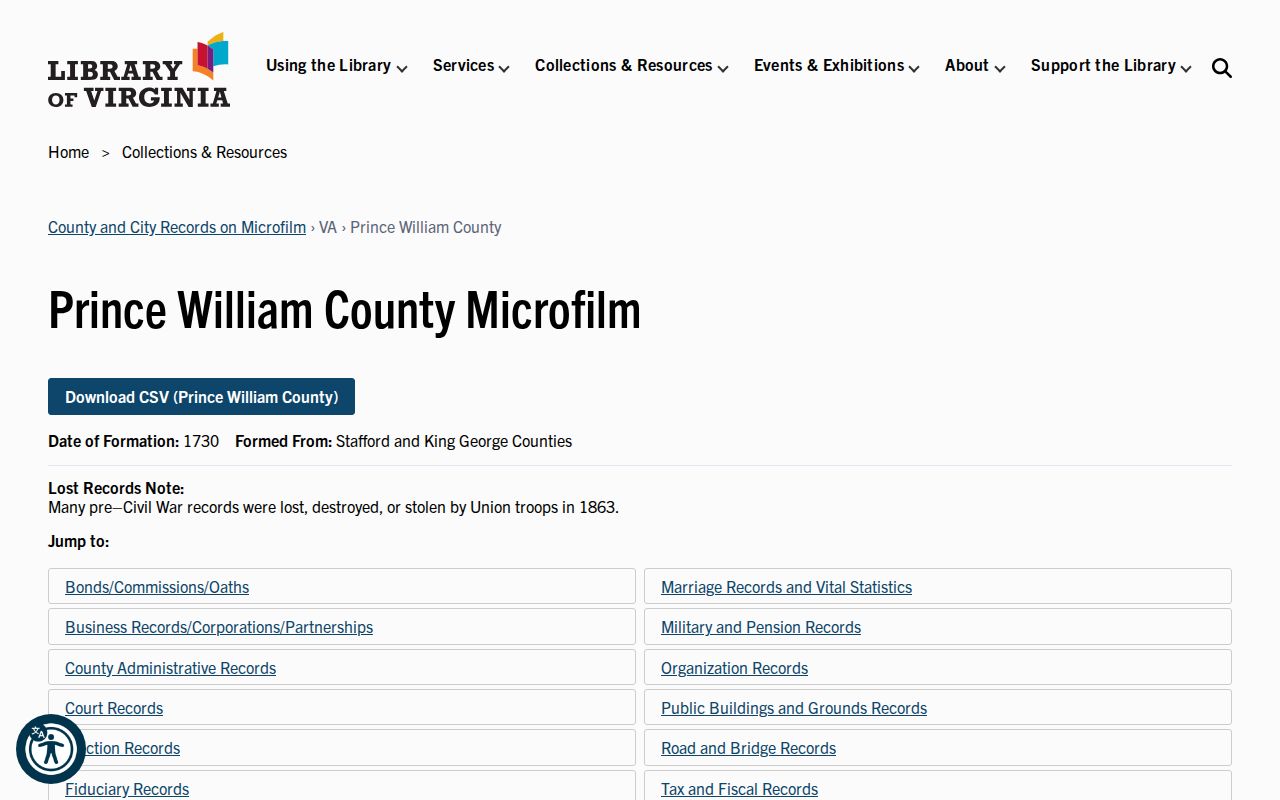
That catalog lets you identify record types before a visit or a copy request, especially where online coverage stops at a date boundary. For the local volumes themselves, the RELIC directory article describes the books, their entry patterns, and their criss-cross uses.
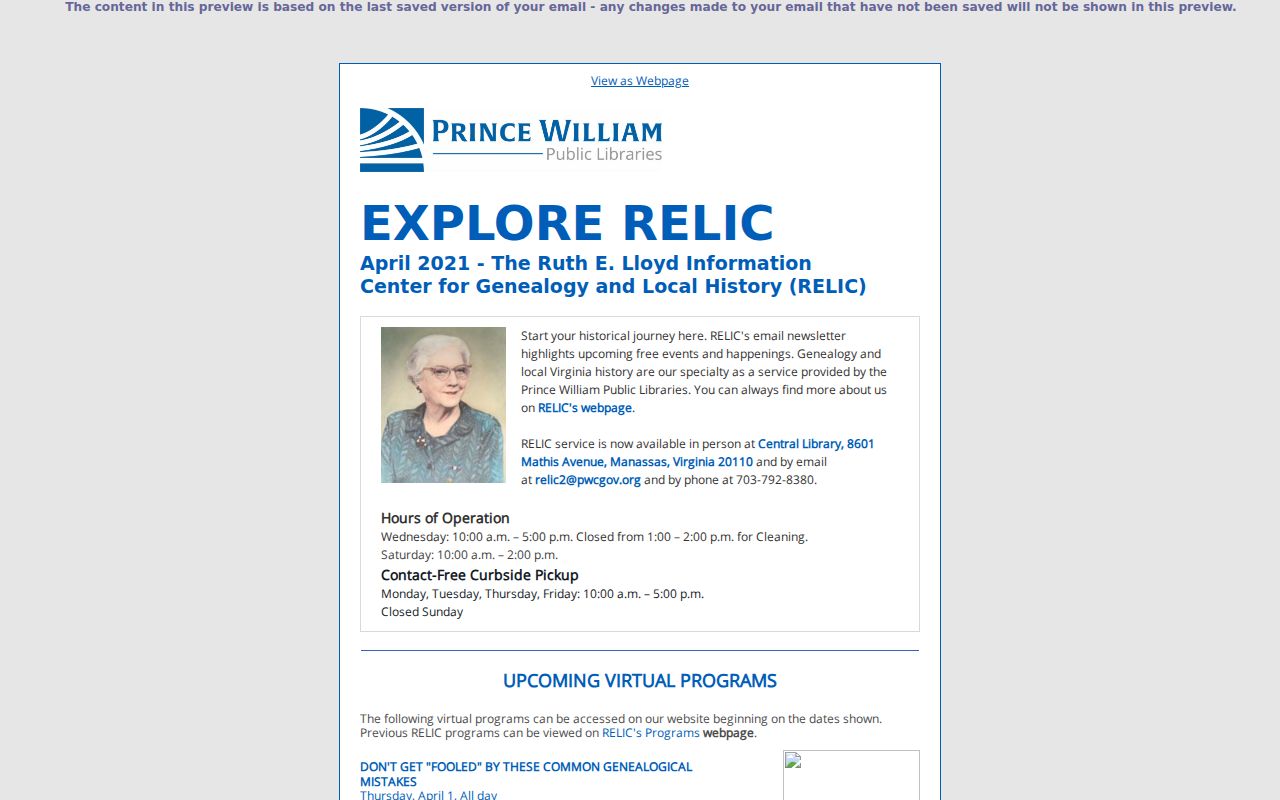
The article shows why every entry needs a date and a geographic scope checked first. Treat it as a match only after both line up.
Trace Prince William County City Directory Families
Treat each Prince William County volume as one dated snapshot. Start narrow. Pick the target street and a tight time range. Then confirm what territory the title actually covers. Read the alphabetical entry first. Follow with the street or criss-cross section when the edition has one. A printed address without the household name you expect may reflect an abbreviation. It could also be a changed street suffix, a business entry, or a telephone-book listing. The goal is a documented sequence. That is not a fast guess that two similar names belong to one person.
- Find the first local edition that fits the town, corridor, or county area and record its title, year, and page.
- Follow the printed name through later and earlier editions, saving each address, occupation, household notation, and directory section.
- Check the street or criss-cross portion when the edition has one, then note nearby listed households as context rather than as proof of a relationship.
- Pair the directory dates with federal census material, local tax or land records, and the dated newspapers or obituary indexes at RELIC.
- Test a historical address in County Mapper only after old numbering or street names have been converted to a current candidate.
A disappearance from the city directory can mean many things. A move, a death, or a changed listing practice all look alike on the page. So does a gap in the run or an incomplete edition. An obituary can anchor an exit date. But push toward a vital, probate, or court record for confirmation. When a historical entry needs checking against the present, take the Prince William County resident lookup route rather than treating the old volume as current evidence.
Prince William County Directory Gaps
Early gaps deserve a written research note, not a guessed answer. Prince William County was organized in 1731. The county-seat move to Manassas is best described as a transition from 1892 to 1894. Official and custodial pages differ. Civil War raiding destroyed or scattered records. The Brentsville self-guided tour reports 16 deed books and five will books lost. So a missing early deed or will does not mean no transaction ever occurred.
For a break before modern land-record coverage, work outward. Check the Clerk index or an adjacent instrument first. Then move to RELIC indexes and microfilm. Library of Virginia county-court microfilm and Chancery records follow. So do tax lists, census abstracts, church or cemetery collections, newspapers, town lots, and historic maps. The 1890 Prince William County substitute indexes vital, court, and tax material. It covers the gap after the federal census loss. Mark the break, note the source checked, and name the next custodian.
Note: Historical directory evidence is strongest when the edition, page, and locality agree. Add a second dated source.