
Prince William County Resident Routes
A useful Prince William County residents directory search starts with the fact already attached to the question. An address belongs first in County Mapper, where the county assigns the parcel’s GPIN and distinguishes the property location from a mailing address. A name can lead to a recorded party, a court index entry, an authorized voter-record channel, or a dated directory listing. Those roles are not interchangeable. An owner may be an entity, a mailing address may sit elsewhere, and a directory entry can document an earlier household rather than a current one.
Keep the returned name spelling, unit, GPIN, date, and source beside each result. That small record trail makes a later confirmation possible. It also avoids turning a parcel, court, or business entry into a claim about who occupies a home. The county did not publish a single official, comprehensive list of everyone at every address, so the reliable route is role-based and cross-checked.
- Enter the complete address in County Mapper and preserve the GPIN, unit, and returned parcel location.
- Open the Real Estate Assessments profile to separate owner, mailing, assessment, and transfer fields.
- Use the Circuit Clerk index for a named party or parcel-linked instrument, then request the actual record when needed.
- For an older household, compare the proper RELIC directory edition with a census, tax, newspaper, or probate lead.
- When an existing record is not online, ask its custodian for a defined record and date range rather than requesting a list of occupants.
Prince William County Records Offices
Three custodians handle most first checks. Tax Administration connects an address to the current parcel profile. The Circuit Court Clerk keeps the land-record and court channels. Elections manages the individual voter service and statutory list process. Each office has a different scope and disclosure rule. For a complete address sequence, the Prince William County street directory follows the parcel, map, and deed trail by street.
Circuit Court Clerk, Land Records
Judicial Center, 9311 Lee Avenue
Manassas, VA 20110
703-792-6015
Tax Administration, Real Estate
Property and assessment questions
Prince William County, Virginia
703-792-6780
Prince William Office of Elections
9250 Lee Avenue, Suite 1
Manassas, VA 20110
703-792-6470
Prince William County Parcel Keys
County Mapper is the county’s normalization tool. Its address mode accepts street number, a required street name, street type, and a unit where needed; it also has a multi-tenant option. The same viewer can search a partial GPIN, an intersection, coordinates, or a selected layer. A GPIN is a unique parcel identifier based on the parcel centroid. It is a stable research key, but it does not encode every past boundary or owner and may change after an adjustment or plat.
| County Mapper input | Use in a resident-record trail |
|---|---|
| GPIN | Links a returned parcel to Tax Info, parent-child history, and map layers. |
| Street number, name, type, unit | Normalizes an address, especially where a unit or multi-tenant setting matters. |
| Intersection or coordinates | Finds a parcel area when no finished street address is available. |
| Results tools | Provides highlight, More Info, List Adjoiners, and map context for the returned parcel. |
The official County Mapper returns parcel-oriented context, not a household roll. The captured screen shows the map-and-result environment used to begin a property-linked check.
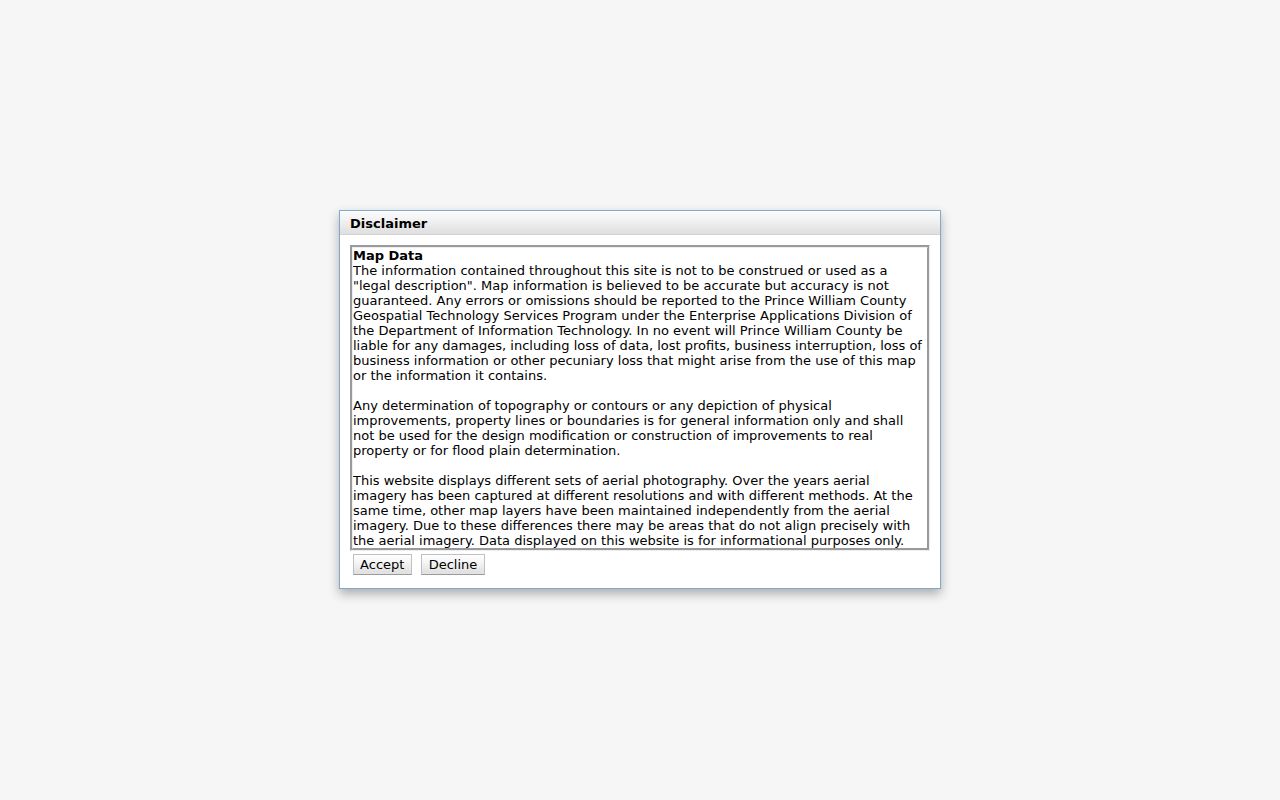
Use the result’s GPIN and address as citations for the next portal, then confirm ownership or legal boundaries with the appropriate custodian.
Prince William County Deed Trails
The Circuit Clerk’s remote PublicSearch service covers Prince William County, Manassas, and Manassas Park. It offers registration, sign-in, a knowledgebase, and property-alert entry, but the unauthenticated inspection did not expose its live search fields or image permissions. Describe it as an index and document-access route, not as a complete online file room. The published coverage is more specific: land records and plats run from 1918 forward, judgments from 1988, fiduciary indexes and images from 1981, and UCC material from 1989.
When a remote result stops short, the Clerk provides public computers for many current scanned cases and accepts copy requests at circuitcourt@pwcgov.org. A useful request identifies parties, document type, page count, certified-copy choice, and an instrument number or book and page. The form lists copies at $0.50 per page and certification at $2 per document, while the current fee page controls if rates change.
The PublicSearch entry screen is shown here because it is the county’s official remote starting point for registered users.
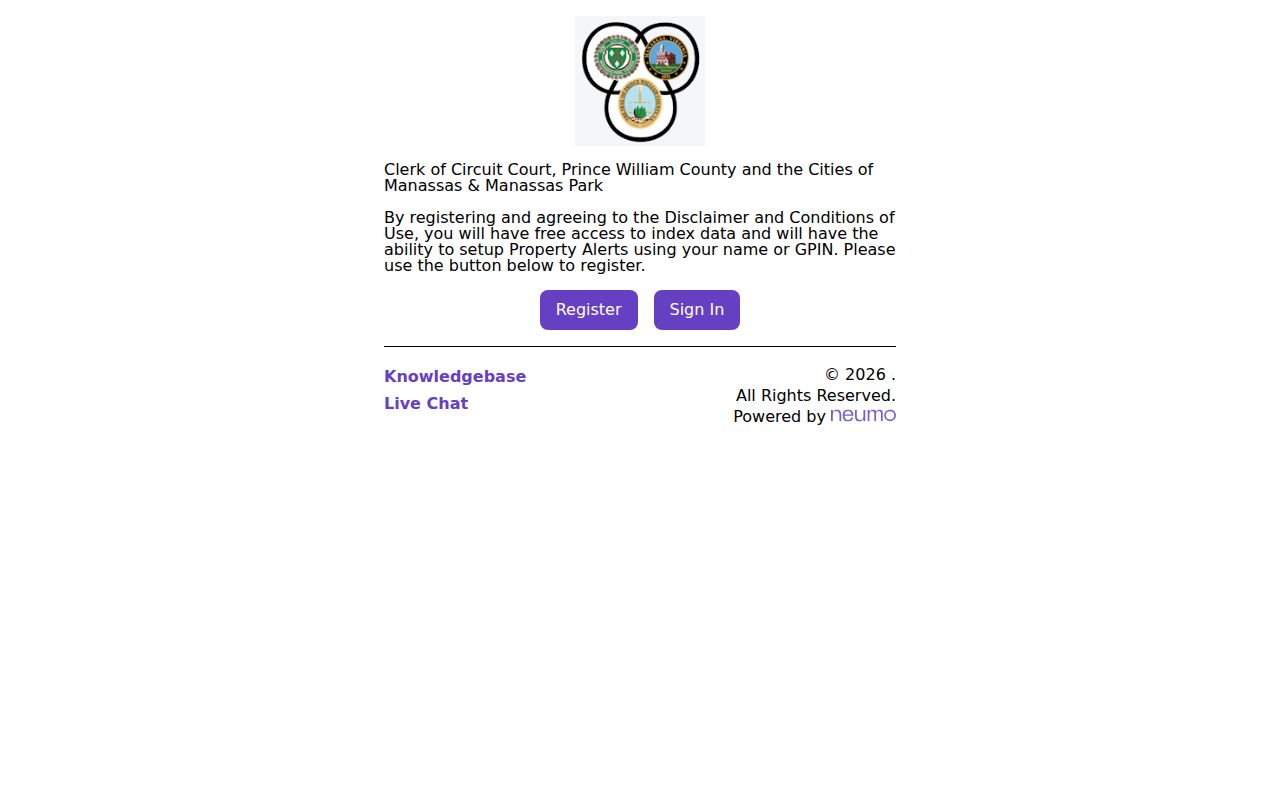
A recorded grantor or grantee is a party to an instrument. That fact should be kept separate from a conclusion about present residence.
Prince William County Current Records
Current sources answer different, limited questions. The assessment profile can show an owner or taxpayer display, a mailing and situs split, GPIN, account, improvements, values, and transfer history. The deed index identifies recorded parties. A voter product follows Virginia’s statutory rules. A business or license result may identify an affiliation or address of record. None should be relabeled as a universal Prince William County residents directory.
| Source | Who It Lists | Keeper | Access |
|---|---|---|---|
| Assessment and parcel profile | Owner or tax role | Tax Administration | Real Estate portal and County Mapper Tax Info |
| Recorded instrument index | Grantor, grantee, or other named party | Circuit Court Clerk | PublicSearch, Clerk computers, or copy request |
| Voter service and list route | Registration information under statutory limits | Virginia Elections and local registrar | Individual portal or authorized list process |
| Historical directory | Dated householder and address clue | RELIC | Physical or microform collection |
| Association listing | Association geography and contact fields | Neighborhood Services and GIS | Voluntary listing and ArcGIS layer |
For one named person, start by defining the role to be verified, then use independent sources with a date and place check. The Prince William County resident lookup explains that narrower task. For a historic household, a printed directory may be a better fit than a current portal.
| Official custodian route | Compiled people-search category |
|---|---|
| Identifies the office, record class, date, and access rule behind a result. | May combine files from different dates and sources without a clear custodian trail. |
| Allows a reader to request the underlying instrument, file, or collection from its keeper. | Can contain stale addresses, duplicate names, merged people, or protected details that require caution. |
| Supports a narrow label such as owner, recorded party, voter-status route, or dated householder. | Does not replace verification with the county, state, court, library, or other official custodian. |
Use a compiled result, if encountered, only as a lead to an original source. Prince William County records are more useful when the reader can see the record’s date, purpose, and keeper. That context prevents a simple name match from becoming an unsupported story about a person or a home.
Prince William County Voter Boundaries
The Virginia citizen voter portal is an individual service for registration or updates, polling place and district information, absentee status, and voting-history access. Its dynamic field labels were not captured in the research. Public inspection of registered-voter lists occurs under Virginia law, while broader list products carry separate eligibility and use controls. The state form asks for locality, district, election type, start date, product, and optional recurring months.
Virginia’s listed voter fields can include name, address, year of birth, gender, and applicable districts, but the law excludes Social Security information, registration-agency identity, day and month of birth, and protected address details. VERIS records and individual voting history are not ordinary FOIA requests. A portal result or list entry is not a license to expose protected data or infer a household.
Note: Prince William Office of Elections pages show two weekday closing times, so confirm hours before visiting.
Prince William County Record Checks
Court and vital sources help confirm a narrow event or record role. In General District Court, select one court and use a required last name with optional first, middle, or suffix fields; a case number or hearing date is another path. Current results are after January 2007, archived results are before January 2007, and the clerk remains the custodian of the actual file. The Circuit portal also works one selected court at a time, with no statewide civil circuit search.
Prince William Health District Vital Records serves Virginia births from June 14, 1912 forward. Birth records become public after 100 years; death, marriage, and divorce certificates become public after 25 years. Earlier access is generally limited to immediate family, an authorized representative, or another qualifying route. Its online application uses event type, names, date/place, requester details, identification, e-signature, payment, and tracking fields as the certificate requires.
The Prince William Health District Vital Records page shows the official local request channel.
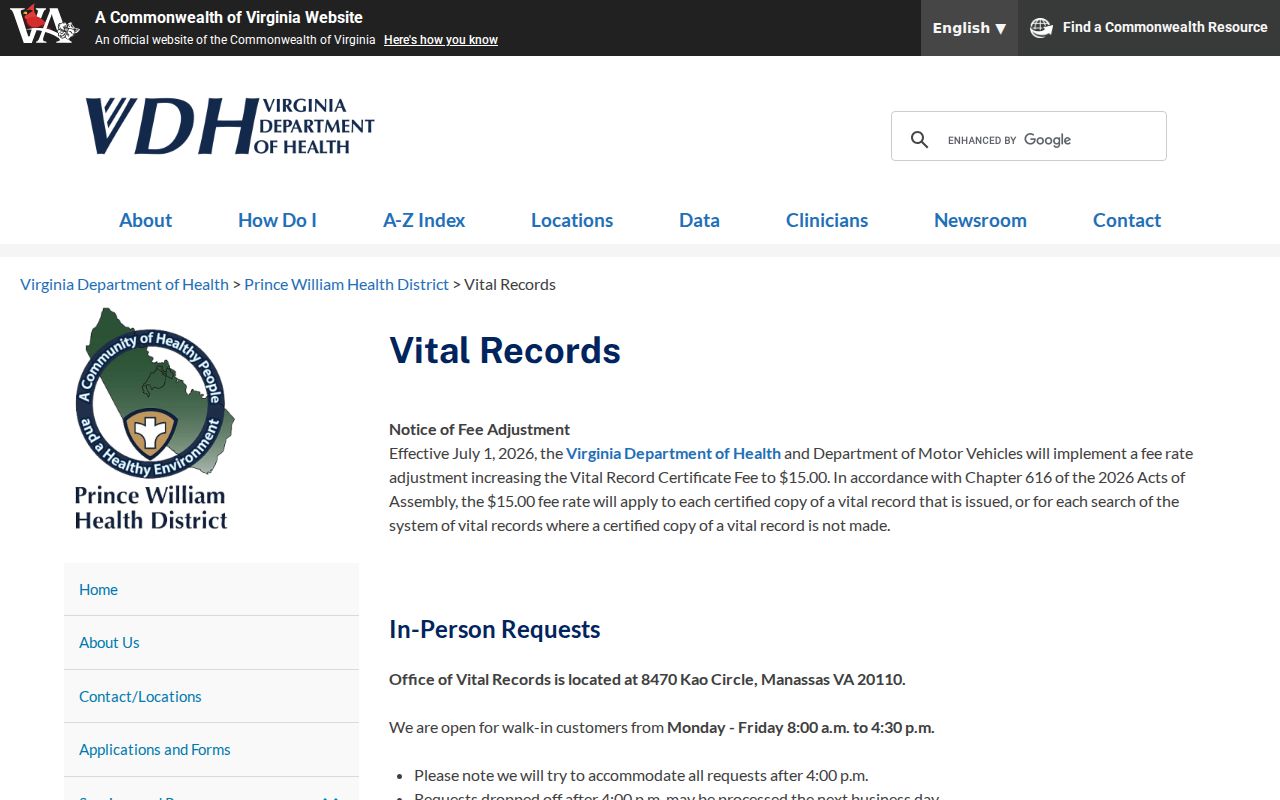
Use the public-window and relationship rules before requesting a certificate, rather than assuming a name search will expose it.
Prince William County RELIC Help
RELIC, the library’s local-history and genealogy collection, is the human-use layer in a records search. Staff help with people, places, and events, and the digital-preservation lab is free to use. Its Tree Doctor service offers virtual research appointments through the library. This is the right handoff when a portal has no old entry, an address changed form, or a family needs a dated local source rather than a modern parcel profile.
Its holdings include local newspapers, obituaries, yearbooks, county records, and directory volumes. The official RELIC page displays two different staffed-hours blocks, so call before an in-person visit. The collection is at Central Library, 8601 Mathis Avenue, Manassas, with a published phone number of 703-792-8380.
Library access adds more than shelves. Prince William Public Libraries provide Ancestry Library Edition at branches and HeritageQuest remotely to cardholders. RELIC can direct a question to county microfilm, chancery, cemetery, church, newspaper, or school material when a directory alone is thin. Ask for the person, place, record type, and date range. That makes staff help more efficient and preserves the distinction between a historical lead and a current address claim.
Prince William County Historic Directories
Historical directories preserve dated household clues, not modern occupancy claims. RELIC holds Manassas city directories from 1960 through 1983, Quantico through Occoquan corridor volumes from 1963 through 1980, and county editions for 2001 and 2007 through 2020. Telephone books span 1903, 1931, 1941, 1951, and a 1958 through 2009 run with gaps. A printed householder, occupation, or address needs its edition and page recorded beside it.
Pair a directory year with a census, tax list, newspaper, deed, or probate record. A criss-cross directory indexes an address route and can be especially useful after a name has been tied to a known street. The Prince William County directory book has the collection-by-collection history and access detail.
- Parcel
- A mapped piece of land associated with a GPIN and assessment record.
- Index
- A finder tool that points to a record or document; it may not include the image itself.
- Criss-cross directory
- A reverse directory arranged to connect an address with a dated listing.
- Roll
- A record set maintained for one purpose, such as assessment or voter administration.
Prince William County FOIA Route
Virginia Freedom of Information Act requests can seek existing county records with reasonable specificity. Under Va. Code § 2.2-3704, the public body generally responds within five working days by producing records, citing a withholding rule, saying none exist, or explaining the need for more time. The county may charge actual costs and can require a deposit for an estimate over $200.
Name the department, record type, date range, GPIN, address, or case number, and ask for an electronic copy or fee estimate where useful. Send county FOIA questions to foia@pwcgov.org or call 703-792-6620. Clerk documents are ordinarily requested from the Clerk’s public-record channel, not through a broad FOIA demand.
The county FOIA page identifies the official channels and records-request guidance.
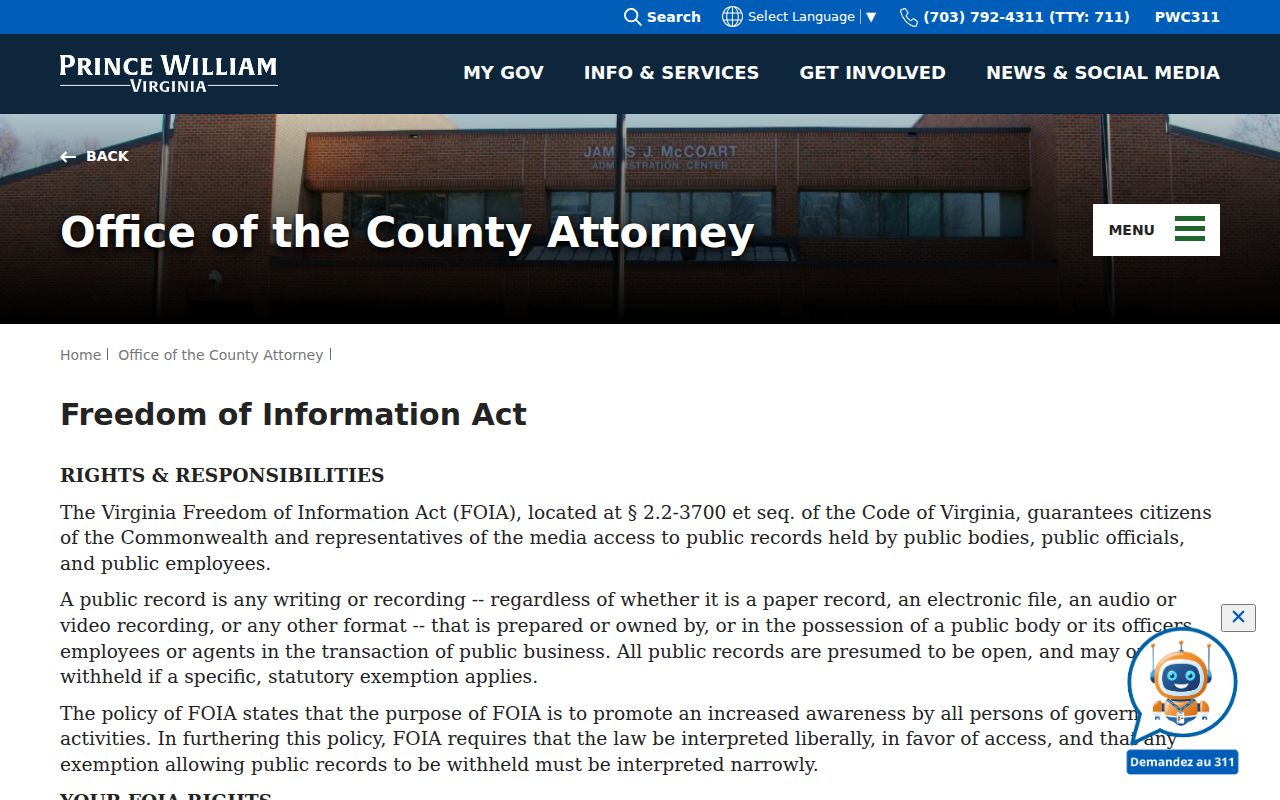
A precise request for an existing record is more useful than a request to create a directory or identify every person connected with an address.
Prince William County Privacy Stops
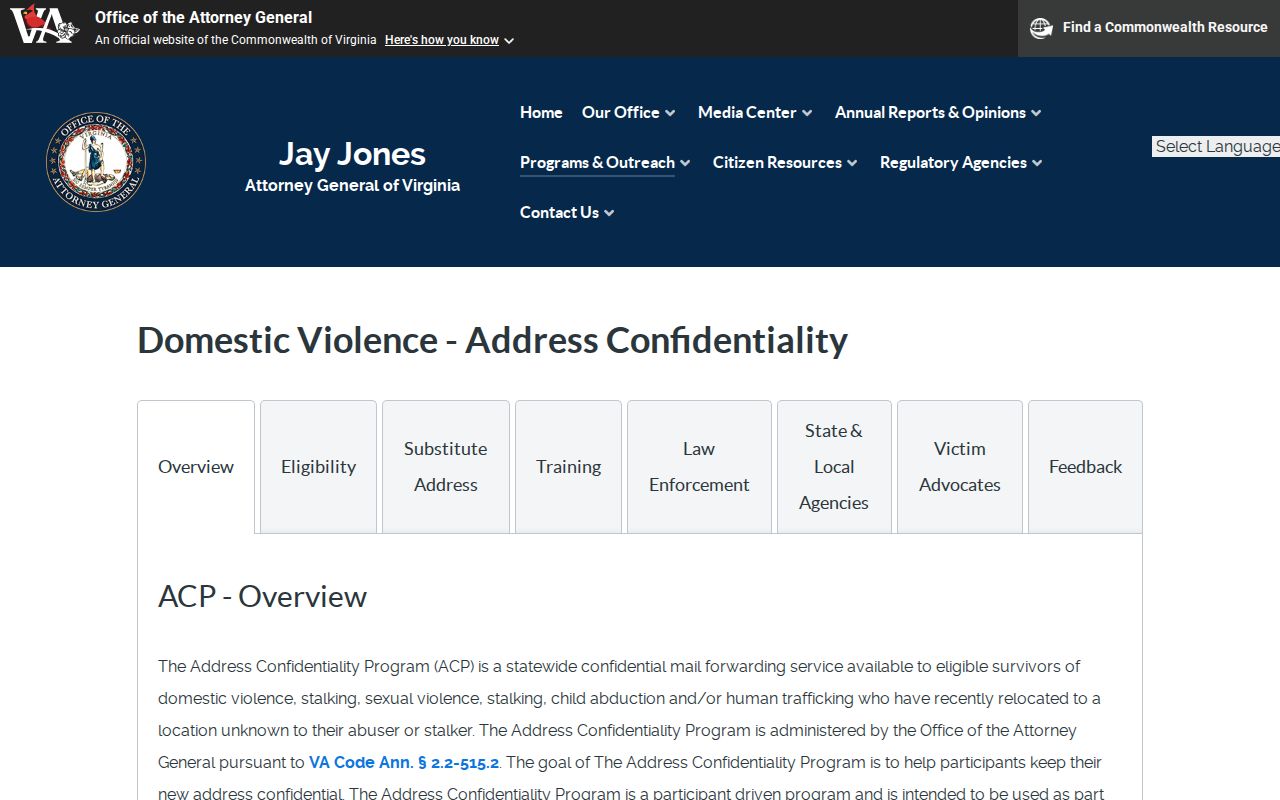
Some records are public only in a limited form, and others are protected. Virginia’s Address Confidentiality Program gives eligible participants a substitute address that does not reveal the physical address. A visible mailing address in a different record is never a reason to reverse-engineer a protected location. Court, vital, voter, juvenile, sealed, and DMV information each carry their own rules.
The Virginia Address Confidentiality Program explains the state safeguard.
When the strongest source has a confidentiality restriction, treat that restriction as the end of the public research trail.
Prince William County Claim Leads
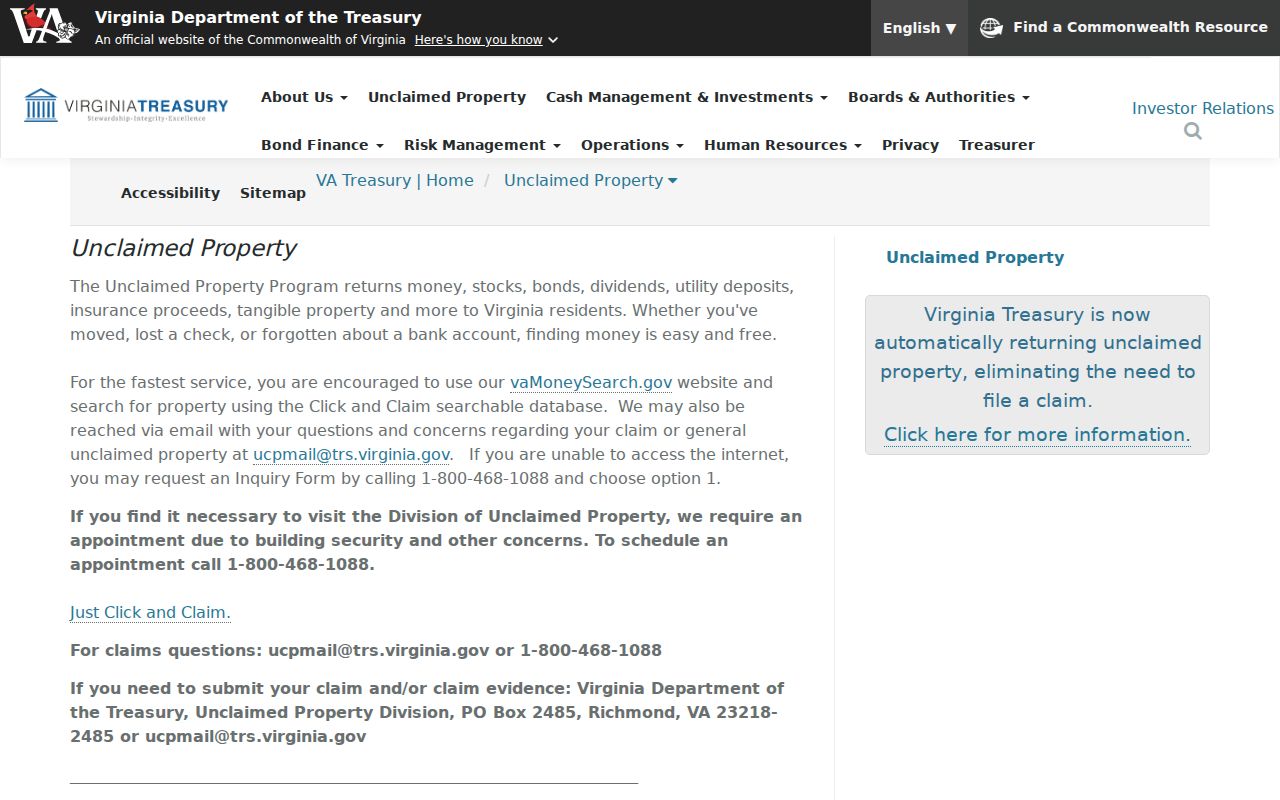
Virginia Treasury’s unclaimed-property program is a focused name-and-address lead rather than evidence of a home address. Its free vaMoneySearch Click and Claim database accepts a person or business name, then asks a claimant to support the claim. It can include money, stocks, bonds, dividends, utility deposits, insurance proceeds, and other property. Users without internet access can request an inquiry form through the Treasury.
The Virginia Unclaimed Property page directs claimants to the state’s official search service.
A possible claim should be confirmed with the Treasury and the claimant’s own evidence, not treated as proof of residence.
Prince William County Portal Stops
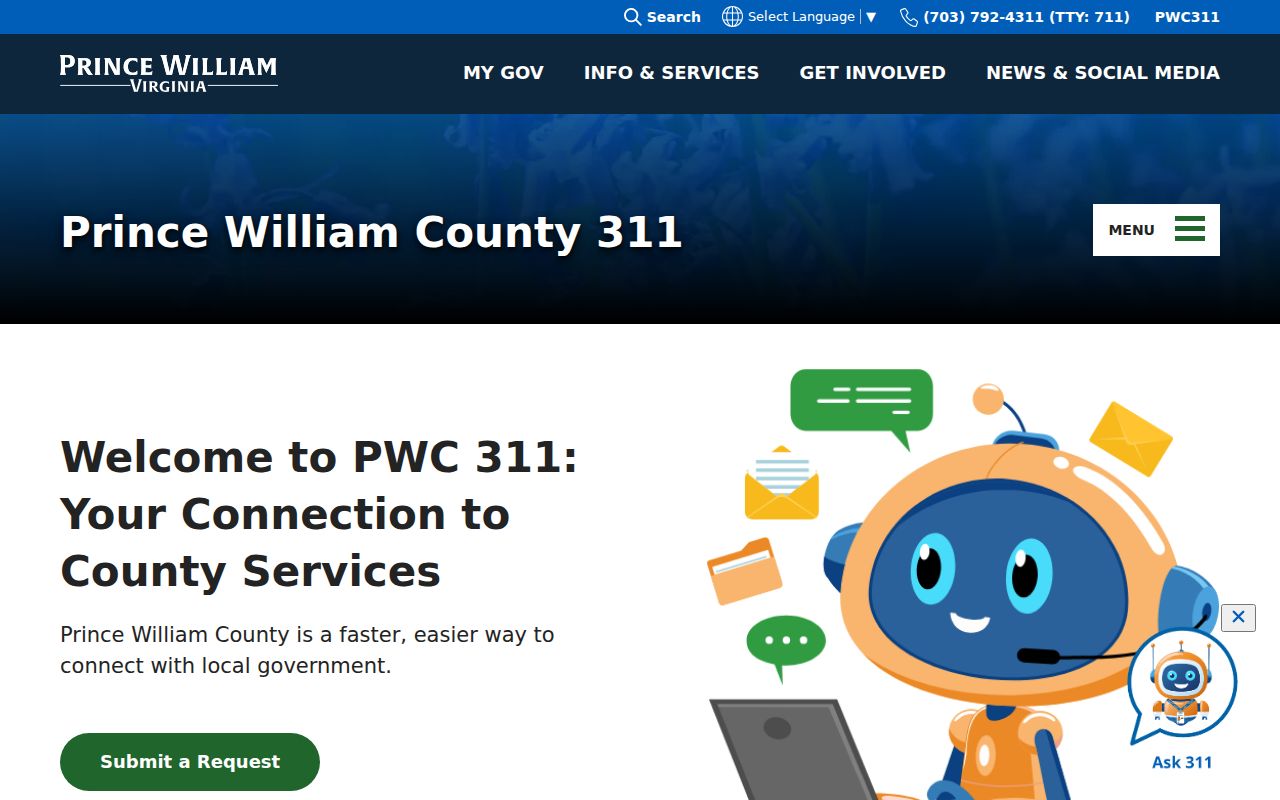
Online access is only one channel. When a search stops at an index, move to the record custodian: the Clerk counter or copy form for deeds, the Tax Administration contact for owner-field questions, the Health District for eligible vital requests, RELIC or the Library of Virginia for older material, and county FOIA for defined existing county records. The county’s PWC 311 service routes records requests to FOIA and warns users not to submit sensitive data there.
The PWC 311 page is useful for general county service routing, but it is not a substitute records-request desk.
The right next step is the office that holds the record type, not a wider name search.
Prince William County Custody Routes
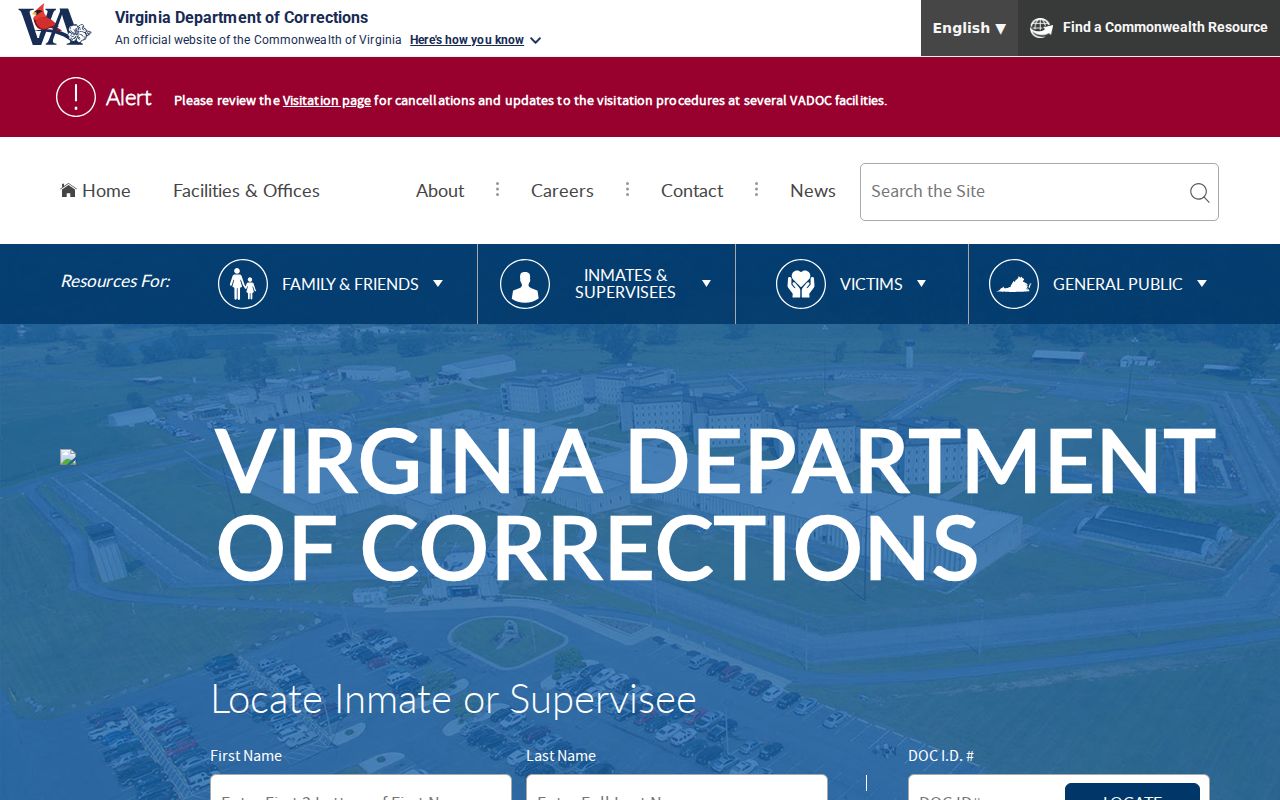
No official public web roster was located for the Prince William Adult Detention Center. For current custody, charge, bond, next-court-date, or sentenced-release questions, the county directs callers to 703-792-6420. The statewide Virginia Department of Corrections locator and Virginia VINE/NAAVI are different services for state-custody and notification information. They should be used only for their stated purpose and with the published accuracy limits in mind.
The Virginia Department of Corrections locator offers the state route.
A missing online row is not a finding about any person, and an official phone or custodian is the required fallback.